


Temperature rise and temperature differentials during cement hydration can create tensile stresses that lead to early‑age thermal cracking in concrete elements.
In higher‑risk structures, limiting peak temperature can also be important to reduce the risk of Delayed Ettringite Formation (DEF), which may contribute to expansion and cracking later in the service life.
EVOLVE™ is Boral’s proprietary 3D finite element thermal modelling tool designed to predict temperature development and temperature differences within concrete elements.
It helps project teams understand thermal risk early so mix designs and preventative measures can be planned before construction begins.
Request a quote now
Features and Benefits

Thermal risk prediction
Predicts temperature rise and temperature differentials within concrete elements to support early‑age thermal cracking risk assessment during design.

Accuracy using local materials
Built on extensive experimental testing of Boral’s in‑house materials, providing greater confidence than models based on international data.

Informs cost‑effective controls
Helps guide mix and construction decisions that can reduce the need for thermal controls such as chilled water and ice, where appropriate.
EVOLVE™ at a glance
Best for
- Higher‑risk concrete elements where temperature rise and gradients need to be assessed during design.
- Projects where early‑age cracking risk needs to be mitigated before construction.
What EVOLVE™ provides
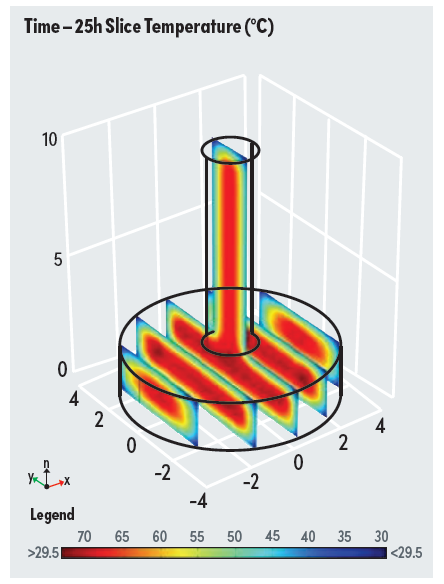
- 3D modelling outputs that help visualise temperature development and differentials within an element.
When to consider thermal modelling
Thermal modelling is most valuable when temperature rise and gradients are likely to be significant, particularly in large or higher‑risk elements where cracking risk can be difficult and costly to manage once construction is underway.
Addressing these issues during the design stage is essential, and EVOLVE™ is designed to support that capability.
Why EVOLVE™ is different
EVOLVE™ has been developed using extensive experimental testing of Boral’s in‑house materials, including collaboration with the University of NSW. This improves confidence when predicting thermal behaviour under Australian conditions, compared with models based solely on international datasets.
Using EVOLVE™ across the concrete construction lifecycle
EVOLVE™ supports planning, placement and curing decisions by combining predictive modelling with temperature monitoring across the concrete construction lifecycle.

How EVOLVE™ works
EVOLVE™ is a 3D simulation finite element model used to predict temperature development and temperature differences across a concrete element, helping teams understand the risk of thermal cracking.
Step‑by‑step
- Define the element geometry and construction conditions to be modelled.
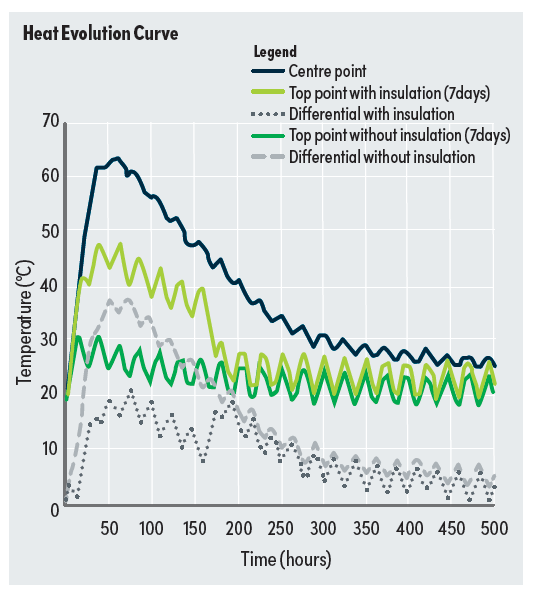
- Predict temperature rise from cement hydration and the temperature differential between interior and exterior zones.
- Use insights to evaluate mitigation options such as mix design adjustments or construction controls to manage cracking risk.
Technical background
Temperature rises can create a range of issues for concrete, particularly in large elements during cement hydration.
Limiting peak temperature can be important to reduce the risk of DEF forming in the future, which may lead to expansion and cracking.
Temperature differentials between a hot interior and cooler exterior can create tensile stresses at the surface, and cracking can occur if those stresses exceed the tensile strength of the concrete.
These issues can lead to early‑age cracking and, in some cases, the production of expansive products that may contribute to cracking after a few years.
Customer insights
EVOLVE™ has been utilised in over 100 projects nationally, including One Circular Quay and Atlassian Central, with strong customer feedback.
Because EVOLVE™ is tested on local materials, it provides greater certainty in predicting thermal behaviour in higher‑risk structures.
This can reduce placing and curing costs by minimising thermal controls sometimes required by consultants, such as chilled water and ice.
Analysing cost impacts
Heat‑related issues can require costly changes such as modified mix designs, the addition of supplementary cementitious materials (SCMs), additional testing, special construction methods, and increased batching costs.
EVOLVE™ helps mitigate the risk of early‑age thermal cracking by enabling these issues to be addressed proactively during design and planning, which can reduce long‑term maintenance and repair costs.

In the Media
Engineers Australia published an article featuring Dr Ali Nezhad, Head of Sustainability and Innovation at Boral, discussing the importance of minimising cracking to maximise long-term performance. Dr Nezhad shared the rationale for EVOLVE™, a modelling tool developed by Boral to predict the temperature differential of concrete more effectively. Watch the video interview for more insights.

Contact us to request a quote
Contact Boral with your project details to discuss modelling requirements, suitable mitigation options and delivery planning.